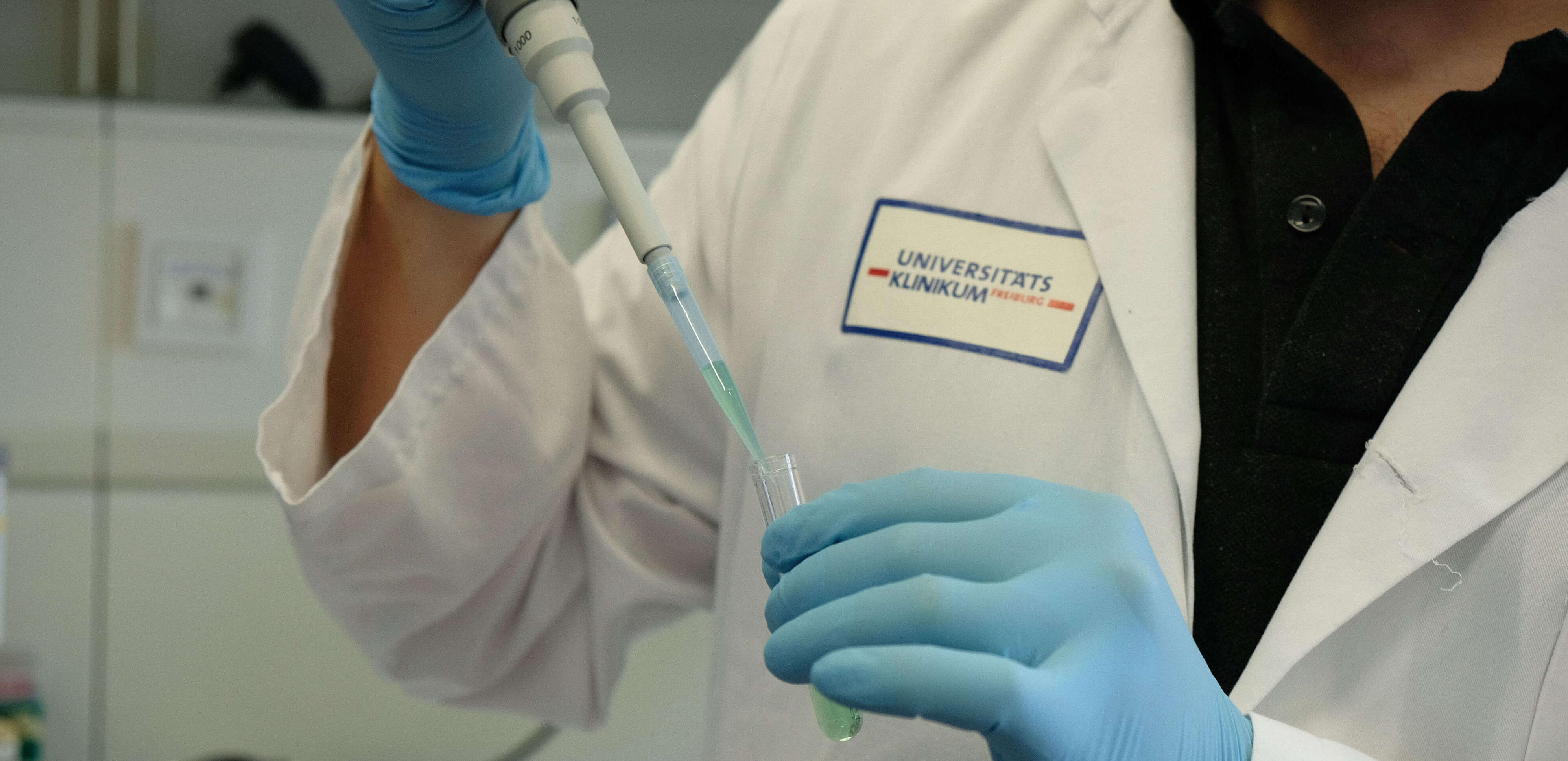
Global healthcare systems are facing major challenges in the light of demographic and social change. Through its Personalised Health focus area, Eucor aims to make a contribution to adapting medical diagnoses, disease prevention and the development of medicines to individual needs, specific environmental influences or genetic differences. With this focus, Eucor also takes up national strategic initiatives from France, Germany and Switzerland and continues them in the European context. Three Eucor member universities have faculties of medicine and university hospitals. In addition, all five member universities have strategic focus areas in the life sciences. Within Eucor's focus areas, “Research, Teaching and Transfer Hubs” (RTTHs) are being established, which is why they are structured into research, teaching and transfer.
Personalised Health in Research
Joint doctoral programme
- The Eucor-coordinated doctoral programme EURIdoc is an interdisciplinary doctoral programme in the field of immunology. The EU funds the programme under the Marie Skłodowska-Curie Actions (COFUND). It comprises 28 doctoral positions for early-career researchers at the universities of Basel, Freiburg and Strasbourg, as well as Karlsruhe Institute of Technology and Freiburg University Medical Centre. Since 2023, the EURIdoc partners have received funding as a German-French doctoral college of the Franco-German University. Among others, the Seed Money projects “Immunology Master Exchange”, “The role of SPATA2 for T-cell activation” and “Exploiting the CXCR4-CD44 axis for cancer treatment” (see below) served to prepare the application.
Cross-border networks
- Researchers in immunology from the universities of Basel, Freiburg and Strasbourg, as well as Karlsruhe Institute of Technology, are connected through the Upper Rhine Immunology Group (URI group) and organise annual clinical workshops and scientific conferences. The EURIdoc doctoral programme builds on the existing close collaboration within the URI group.
- Neurex is a network in the field of clinical and applied neuroscience. Today, this network comprises more than 100 specialised laboratories at the universities of Basel, Freiburg and Strasbourg.
Research project
- The cross-border Clinnova project uses federated learning, a privacy-preserving technique, to enable personalised treatment for chronic autoimmune diseases. In addition to the university hospitals in Basel, Freiburg and Strasbourg, as well as the universities of Basel and Strasbourg, further international partner institutions are collaborating on this project.
Interreg project
- In the AUTOMETA project, the universities of Freiburg and Basel are working with further partners to develop automated sample preparation on a microfluidic chip for metabolomics analysis, in order to improve diagnoses and support personalised treatments.
Seed Money projects
- The project Exploiting the CXCR4-CD44 axis for cancer treatment (2019–2022) aimed to strengthen research cooperation between the Eucor partners with regard to the role of the CXCR4-CD44 axis in cancer treatment. It also contributed to the establishment of the joint doctoral programme EURIdoc.
- The project The role of SPATA2 for T-cell activation (2018–2021) aimed to investigate the role of SPATA2 in T-lymphocyte activation and to strengthen research cooperation in the field of immunology. The collaboration also contributed to the establishment of the joint doctoral programme EURIdoc.
Eucor has determined several thematic areas of cooperation to utilise joint strengths and pool competencies. These focus areas were defined after analysing potentials, locations and existing collaborative projects. Based on specific themes, the member universities establish consortia that are capable of conducting internationally visible and competitive research, while maintaining close ties to teaching and innovation. The main focus areas of Eucor are
- Quantum Sciences and Technology
- Personalised Health
- Sustainability
- European Identities.
Within Eucor, the University of Basel coordinates the activities in the Personalised Health focus area.
Contact:
Siri Leemann
Eucor Coordinator for the Personalised Health Focus Area
siri.leemann[at]unibas.ch
Personalised Health in Teaching
Joint degree programmes
- The Master’s degree programme in Biochemistry and Biophysics with a double degree from the universities of Freiburg and Strasbourg offers advanced, interdisciplinary training in biochemistry, physical chemistry and the methods of biochemistry and biophysics.
- The engineer's degree programme, as well as the Master’s degree programme in Biotechnology and the Bachelor’s degree programme in Biology (specialisation in Biotechnology), are collaborations between the University of Strasbourg (École Supérieure de Biotechnologie de Strasbourg (ESBS)) and the universities of Basel and Freiburg, as well as Karlsruhe Institute of Technology.
Seed Money Projects
- The Immunology Master Exchange project (2019–2022) served to establish teaching collaborations at Master’s and doctoral level in the field of immunology. The joint doctoral programme EURIdoc builds, among other things, on this Seed Money project.
Transfer of Personalised Health
Joint platform
- Biocampus Upper Rhine will position the Upper Rhine region as a leading innovation region for health and medical technology. Existing strengths are to be pooled in order to enable even more innovations in the life sciences. The key areas of action are: startup engagement, entrepreneurship education and industry collaboration.